
How to Search Criminal Dockets
Start with whatever paper you already hold. The citation, bond paperwork, or a prior notice will name a court, and that decides your route. Felonies and other district criminal cases go through the Blanco County District Clerk. They are heard in the 33rd or 424th Judicial District Court. Class A and B misdemeanors belong to the Blanco County Clerk and the constitutional County Court. Class C matters may sit elsewhere. That includes Justice of the Peace Precinct 1, Justice of the Peace Precinct 4, Blanco Municipal Court, or Johnson City Municipal Court. The split matters. Blanco County has no single public search that covers every criminal level.
Match the identifier to the right office. A district cause number stays with the District Clerk. A County Court case number stays with the County Clerk. A JP or city citation should stay with the issuing court. Johnson City publishes no online municipal docket search. Its clerk's phone and email channels are the way in. Federal criminal records are a different world entirely. Those route to the Western District of Texas Austin Division and PACER.
Need a current district setting? Check the district court docket page. Then confirm the date with the District Clerk or the district coordinator. The County Clerk links to TexasOnlineRecords.com for county-level court records. GovRec handles JP citation searches, and Blanco posts municipal docket PDFs. When a portal comes up blank or skips your court, a phone or counter request still gets it done.
- Read the court name and cause or citation number from an official notice.
- Use the matching district, county, JP, or city access channel.
- Compare the cause number, offense, setting type, and hearing date.
- Call the responsible clerk when a result is missing or unclear.
- Request a plain or certified copy if the calendar extract is not enough.
Blanco Criminal Record Formats
Blanco County puts out two criminal reports that look quite different. The district PDFs carry the title "Criminal Docket." They name the 33rd and 424th Judicial District Courts. The constitutional County Court report goes by "RECORD OF CRIMINAL ACTIONS COUNTY COURT." Either one can help you locate a hearing. Neither label promises a complete case file.
The official County Court sample shows the report style, including its arraignment entries.
It helps you tell a plain county misdemeanor action report apart from the richer district setting sheet.
What a Criminal Docket Shows
A district row in Blanco County can pack in plenty: the cause number, setting time and type, offense, degree code, counsel, warrant information, bond, fees, projected costs, continuance count, last court date, a future hearing, related cases, a memo, indictment date, and case age. County Court extracts run shorter, using a compact action format. A blank field means only one thing. The value simply was not printed in that row. It does not prove the underlying file lacks the information.
| Cause number | The court's local identifier, such as cause number shown on notice. |
|---|---|
| Setting | Status hearing, arraignment, or another court event, with time and date. |
| Charge fields | Offense label and the degree or misdemeanor class printed by the court. |
| Counsel and bond | Attorney or appointed-counsel data and any displayed bond details. |
| History | Continuance count, last date, future hearing, case age, and memo when supplied. |
Blanco Docket Codes Need Context
Degree values like F1, F2, F3, and FS are classifications the district report displays. County Court reports lean on MA, MB, or M* to mark misdemeanor class. When you ask the clerk about a row, keep the code as printed. A code alone is not a legal conclusion. Check the charged offense and the file itself first.
- Status hearing
- A check on the case's progress, not a final outcome.
- Reset
- A setting moved to another date, not a dismissal.
- Future hearing
- A later event printed on the report when available.
- Case age
- The report's elapsed-time field, not a measure of guilt or delay by one party.
Stages on a Criminal Docket
A criminal case often starts with a filed charge, complaint, or indictment. Arraignment and pretrial settings follow. Motions and status hearings may appear before a plea or trial. A disposition and sentence can come after that. Still, the public calendar PDF may end before the final order gets posted. Treat the docket as a sequence of court events, nothing more. Want the filing or signed order behind an event? Ask the Blanco County District Clerk or County Clerk for the case file.
Docket flow: Charge Filed › Arraignment › Pretrial Settings › Plea or Trial › Disposition
Blanco Criminal Activity Snapshot
Texas Office of Court Administration figures offer context, not a current party list. In fiscal 2024, Blanco district courts opened with 557 active pending matters across reported categories. They added 317 and disposed of 479, closing at 412 active pending. The constitutional County Court criminal row started at 443 active pending cases. It added 83 and disposed of 120. It ended with 330.
Those totals span the reporting year from September 2023 through August 2024. They measure workload, not counts of unique people.
Which Court Holds Criminal Dockets
Each clerk holds a different slice of the Blanco County criminal docket. The District Clerk holds the felony side. It also keeps other district criminal records for the 33rd and 424th Judicial District Courts. The County Clerk keeps Class A and B misdemeanor records. Those belong to the constitutional County Court. JP1 in Johnson City and JP4 in Blanco keep their own dockets. Each handles Class C cases and citations. Blanco and Johnson City municipal clerks handle city ordinance and municipal Class C matters.
For JP routing, the official JP1 court page gives the details.
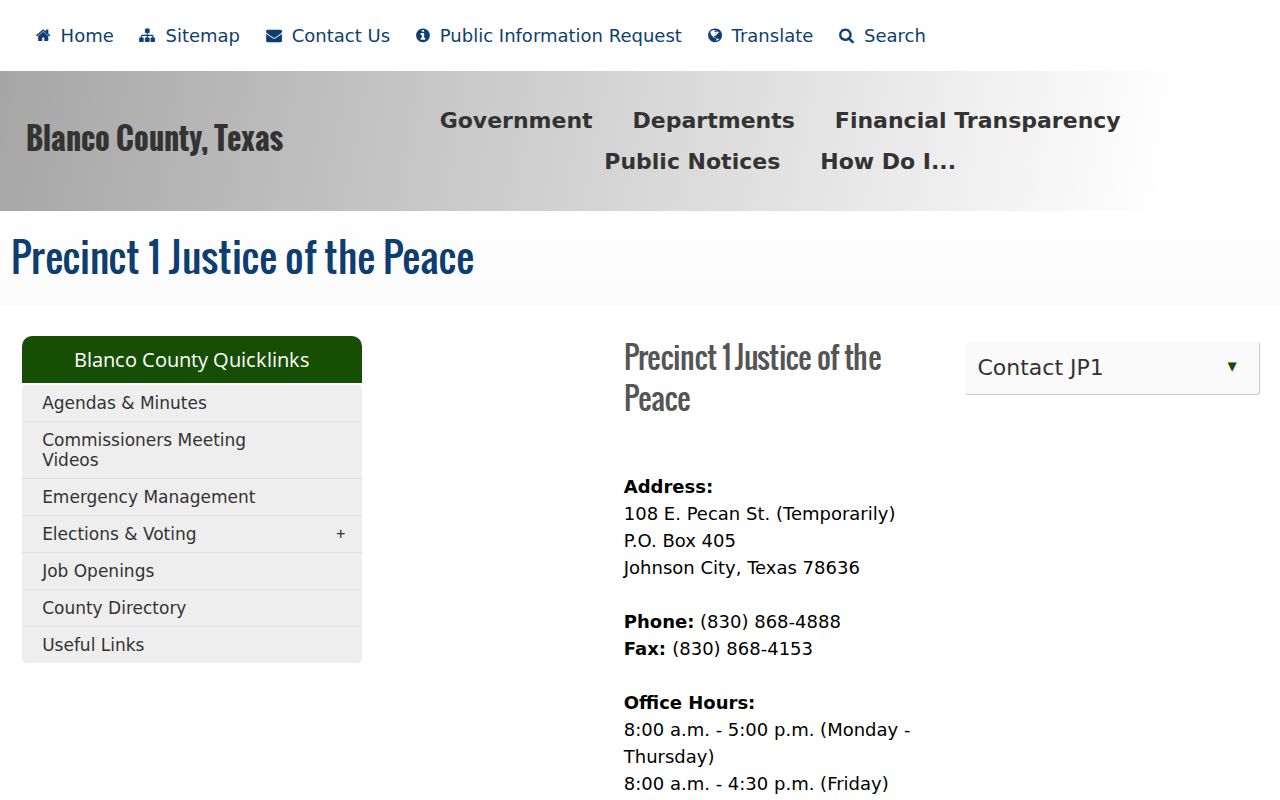
That court page offers the direct local route when a citation belongs to Precinct 1 rather than a district or county court.
The matching JP4 page covers the southern precinct.
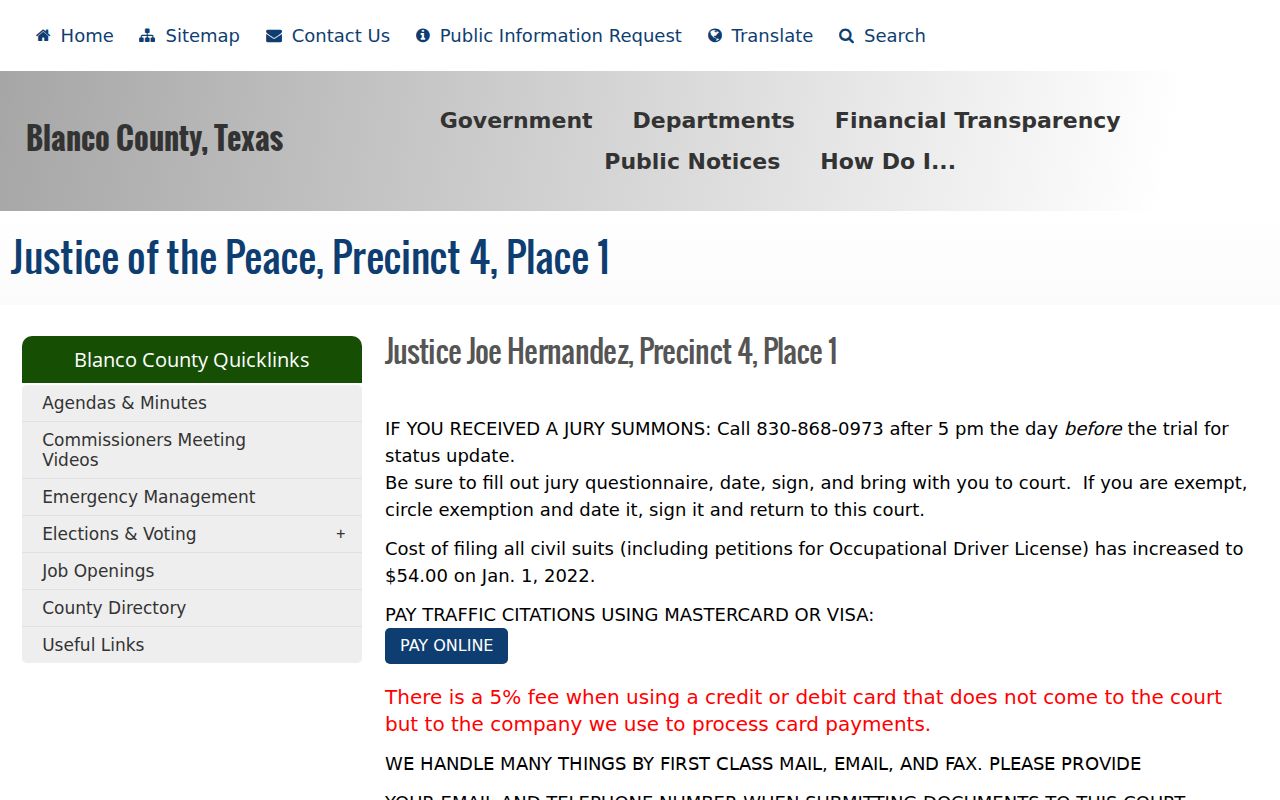
Together, the two JP sources keep a Class C search from landing with the wrong Blanco County clerk.
Blanco Statewide Search Limits
re:SearchTX reaches cases, filings, documents, and hearings across Texas. Yet it skips one big shelf: the Office of Court Administration says criminal case records stay out of the statewide document collection. So a blank result there does not clear a person in Blanco County. Treat it as a partial tool, not a complete Blanco County criminal search. Anything it misses has to come back another way. Try the local district, county, JP, or municipal clerk route instead.
History lovers get more luck. The District Clerk advertises a historical index with criminal case books covering 1878 through 1955 and criminal minutes covering 1959 through 1991. Those fixed collections are great for old research. They just cannot replace the current Blanco County criminal docket, which lives in the clerk's present-day systems.
Request Blanco Criminal Records
A Blanco County calendar shows the setting date. It stays silent on what the judge signed or what a motion asked the court to do. For that level of detail, go to the Blanco County District Clerk. Say exactly what you want: the court, the cause number, the criminal case type, the date range, and the specific item. Written requests go through the office's published email and mail routes, and District Clerk mail lands at P.O. Box 382, Johnson City, Texas 78636. A public search terminal exists too, though renovation notices mean you should confirm its current location before counting on it.
Fees are posted in tiers. A clerk-performed search runs $5. An emailed copy from a specific case costs $1 for the first ten pages, then ten cents per added page. Regular printed copies are $1 per page. Certified copies add a $5 certification charge on top of that $1-per-page amount. Ask for an estimate up front and specify whether you want an ordinary docket printout, a filed document, or a certified copy. No official source promises one standard turnaround time.
Renovation has shuffled terminal access. The District Clerk's terminal is not operating. It sits idle at the temporary Annex office. Its office points searchers to the County Clerk's office at 101 E Cypress for a public terminal and login details. Terminal hours run in morning and afternoon blocks. Call ahead to confirm the hours. Bring the court name plus cause number so your search stays inside the right Blanco County criminal collection.
Misdemeanor papers in County Court belong to the County Clerk, whose mail address is P.O. Box 65, Johnson City, Texas 78636. JP and municipal matters stay with their own local clerks. If a report title is unclear, call the District Clerk at 830-868-0973 or the County Clerk at 830-868-7357. Skip sending private data you do not need to share. Court staff will never call or email demanding personal information or payment, the District Clerk warns. Any payment request should be checked against the official county contact page before you act.
Public Access and Sealed Criminal Dockets
Open criminal settings can be read through court PDFs, clerk channels, and the local systems on hand. Sealed material is different. Confidential criminal-history data, victim information, personal identifiers, and protected addresses may be removed or withheld, and juvenile records carry special confidentiality rules of their own. A missing name or attachment, then, proves nothing about whether a case or filing exists.
Administrative judicial records follow a different door. Texas Rule 12 is different. It sets up its own written-request and appeal framework. Still, it does not replace the Blanco County clerk's process for a criminal case file. State Government Code section 552.0035 likewise recognizes that court rules and other law govern access to judiciary records. Name the record type clearly. That sends your request into the right process from the start.
Access boundary: Texas Family Code chapter 58 protects juvenile records. Family Code section 85.026 protects specified identifying information in protective-order matters. Court case records follow judicial rules and case-specific law rather than an ordinary agency open-records request.